
Fuse Architects + Builders
Fire Resilient Design Put to the Test
At a summer camp deep in the Santa Cruz Mountains, we were asked to design off-grid restrooms that were beautiful, functional, and could withstand a wildfire, all within the budget of a standard wood-framed camp bathroom.
The solution emphasized material honesty and resilience. A central mechanical core made of ground-faced CMU anchors the structure. Around it, stalls and sinks are wrapped in corrugated Corten steel, chosen for its durability, natural weathering, and fire resistance. An angled Corten roof supports a photovoltaic array and extends outward to shelter the exterior wash areas. Water jet-cut panels display the name of each campsite, serving as wayfinding elements and offering a subtle nod to the surrounding forest.
Every element was selected with intention: performance, sustainability, and simplicity.

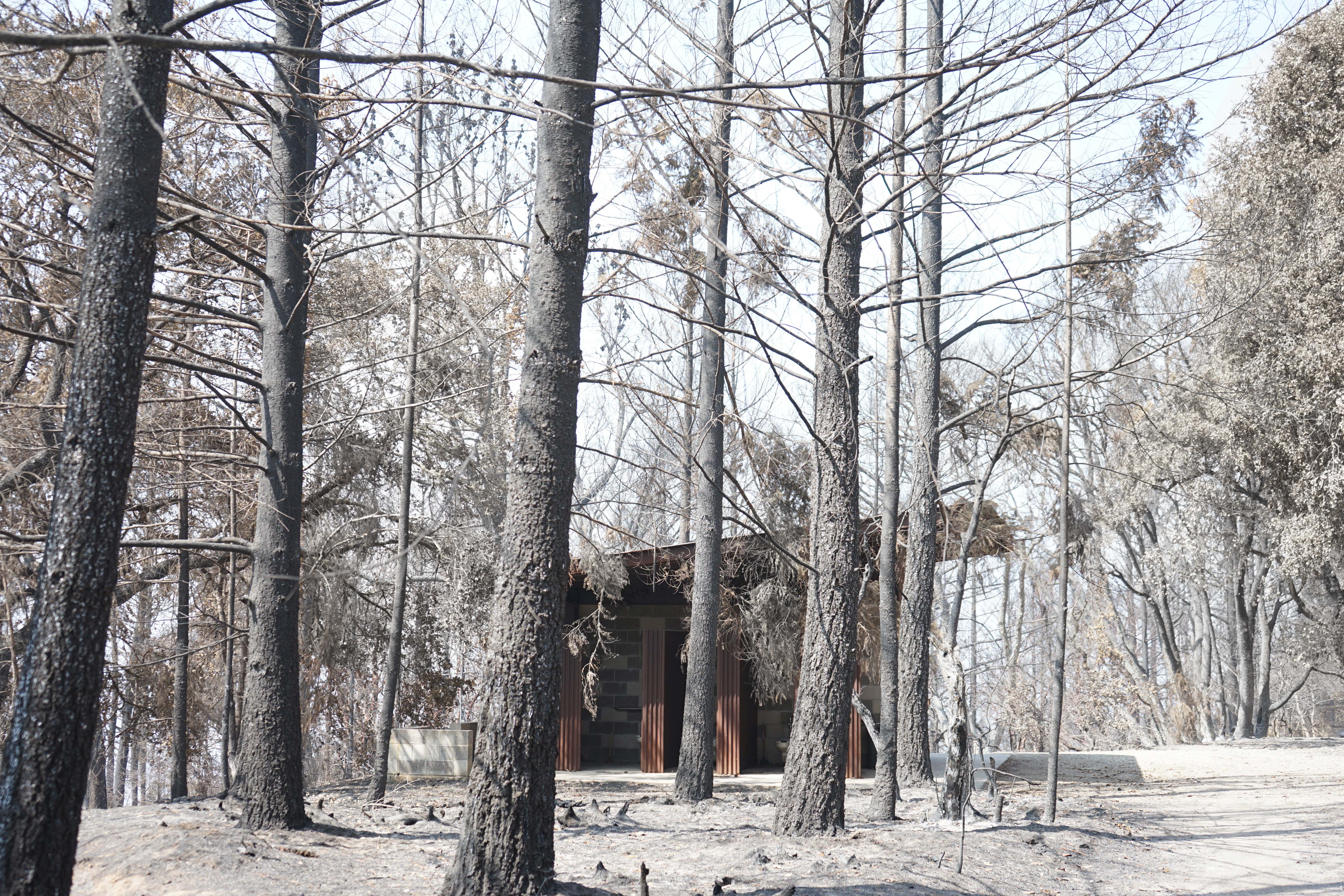
In 2020, the CZU Lightning Complex Fire tore through the region, burning over 86,000 acres and destroying nearly 1,500 structures. The camp was devastated. Every building on site was lost—except these two restrooms. Though the fire passed directly over them, they remained untouched and fully functional. Even the toilet paper was still in place.
This project is a multi-award winning design and model for how thoughtful, low-cost design can meet aesthetic goals while addressing the realities of climate resilience. Built with modest means in a remote location, these structures endure through material integrity and smart design.
As the camp begins to rebuild, we’ve been invited to design a new campus inspired by this approach. This year, we completed two additional restrooms, another step toward a cohesive collection of structures rooted in thoughtful design, environmental stewardship, and long-term fire resilience.


As wildfires persist in California, we have been designing more and more fire-resilient homes for our clients. Read more about our approach to fire-resilient designs and see what a fire-resilient home looks like here.
Wildfire 1: Photographed by Malachi Brooks
Wildfire 2: Photographed by Malachi Brooks
The Camp Lehi restrooms survived a wildfire that destroyed nearly every other structure around them. Here are the questions we hear most about how they endured — and what it means for fire-resilient building.
The two restrooms at Camp Lehi were built from fire-resilient materials: a central mechanical core of ground-faced CMU (concrete masonry unit) wrapped in corrugated Corten steel. When the 2020 CZU Lightning Complex Fire burned more than 86,000 acres and destroyed nearly 1,500 structures, the fire passed directly over these buildings — yet they remained untouched and fully functional. Even the toilet paper was still in place.
Corten (weathering) steel is a self-protecting steel that forms a stable, rust-like patina over time. We chose it for the Camp Lehi restrooms for its durability, natural weathering, and fire resistance. Corrugated Corten panels wrap the stalls and sinks, and an angled Corten roof both shelters the exterior wash areas and supports a photovoltaic array.
Yes. The Camp Lehi restrooms were designed to withstand a wildfire while staying within the budget of a standard wood-framed camp bathroom. The project shows how thoughtful, low-cost design can meet aesthetic goals while addressing the realities of climate resilience — built with modest means in a remote, off-grid location.
Fire resilience comes from non-combustible, durable materials paired with smart detailing. At Camp Lehi we used ground-faced CMU for the central core and corrugated Corten steel for the enclosure — both highly fire-resistant. Beyond material choice, careful siting and simple, intentional detailing all contribute to a structure's ability to endure a wildfire.
Yes. As wildfires persist in California, we've been designing more and more fire-resilient homes for our clients, applying the same principles of material integrity and resilient design proven at Camp Lehi. We've also been invited to design a new campus at the camp inspired by this approach.


